Malachite Stone Identity Sheet
- Name Origin: The name "Malachite" comes from the Ancient Greek "malakos," meaning "soft," in reference to the stone's low hardness and its green color similar to mallow leaves.
- Group: Malachite belongs to the carbonate group.
- Chemical Composition: Malachite is composed of Cu₂CO₃(OH)₂, which is hydrated copper carbonate.
- Crystal System: Malachite crystallizes in the monoclinic system.
- Hardness: Malachite has a hardness ranging from 3.5 to 4 on the Mohs scale.
- Deposits: Malachite is found in several countries, including the Democratic Republic of the Congo, Russia, Australia, the United States, Namibia, Zambia, and Morocco.
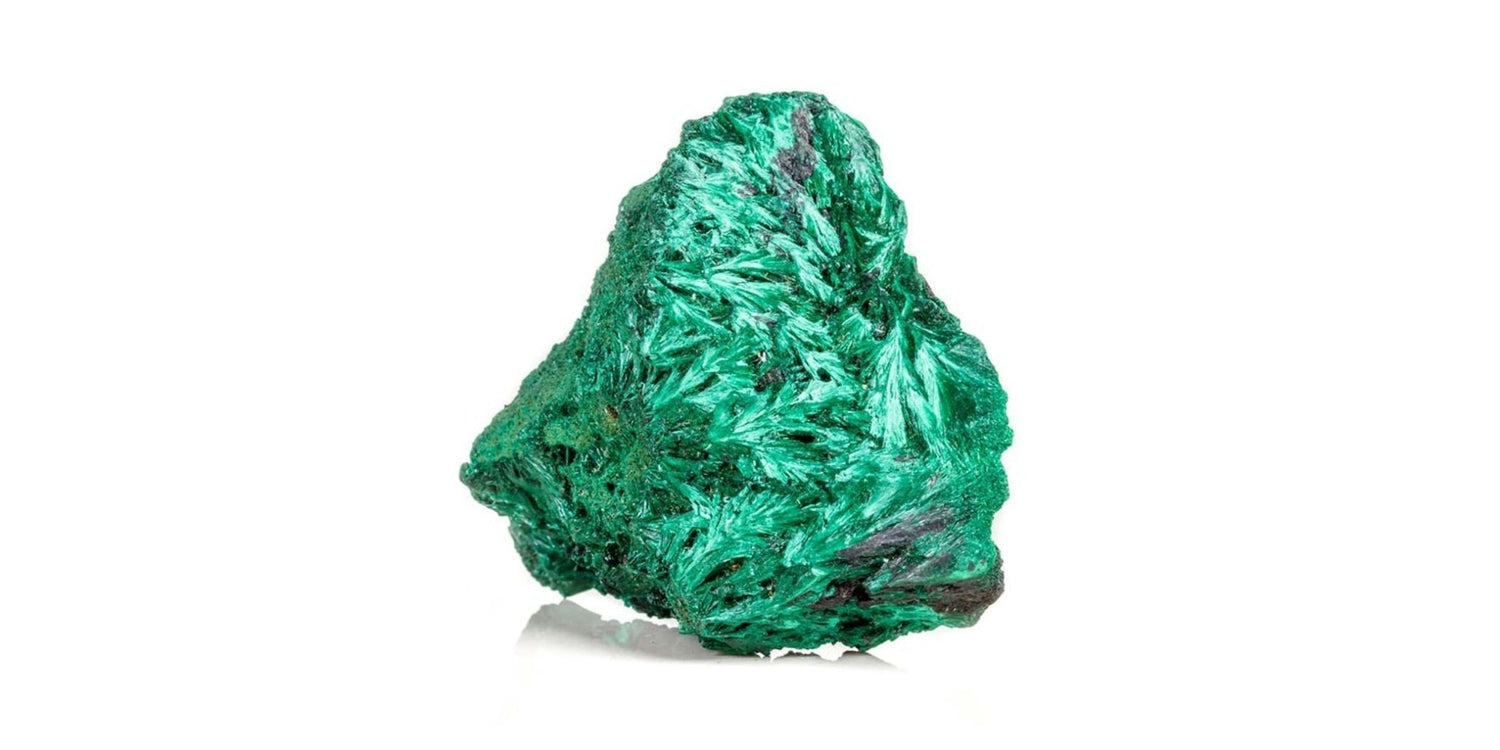
- Color(s): Malachite displays colors ranging from light green to dark green, often with bands or marbling in black or lighter shades.
- Chakras: Malachite is associated with the heart chakra, also known as Anahata.
Where does the name Malachite come from?
The name "Malachite" has its roots in ancient history and linguistics, particularly in Greek and Latin cultures. Its etymology reveals connections with the physical properties and uses of the stone throughout the ages. To fully understand the origin of the name "Malachite," it is essential to explore its etymology, history, and distinctive features.
Etymological Origin
The term "Malachite" comes from the Ancient Greek "malakos" (μαλακός), meaning "soft" or "supple." This name refers to the relative softness of the stone compared to other minerals. Indeed, malachite has a hardness of 3.5 to 4 on the Mohs scale, making it easier to work and carve. The visual appearance of malachite, with its green shades and banded patterns, also evokes the color of mallow leaves (malakhe in Greek), a widely known and common plant in antiquity.
History and Use
Malachite has a long history of use dating back several millennia. The Ancient Egyptians mined malachite in the Sinai Peninsula and used it for jewelry, amulets, and ornaments. It was also ground to create green pigments used in art and cosmetics. The Greek name likely influenced the nomenclature adopted by the Romans, who helped spread malachite throughout the Empire.
Distinctive Features
Malachite is distinguished by its intense green color and banded patterns that range from light to dark green. These patterns are caused by variations in the concentration of copper within the stone. Malachite is a hydrated copper carbonate, with the chemical formula Cu₂CO₃(OH)₂. Its unique green color and optical properties have captivated humanity since antiquity.
Influence and Legacy
The name "Malachite" reflects not only the physical properties of the stone but also its cultural and historical role. The transition of the name through Greek and Latin into modern languages illustrates how the stone has been valued and used by different civilizations. Today, malachite is still appreciated for its beauty and symbolism in ancient traditions.
What is the history of the Malachite stone?
Ancient Origins
Malachite has been mined and used since antiquity. The earliest traces of its use date back to around 4000 BC in Egypt and Mesopotamia. The Egyptians extracted malachite from mines in the Sinai Peninsula. They ground it to make green pigments used in frescoes and cosmetics, especially as eye shadow.
Symbolism and Beliefs
Ancient civilizations attributed magical and symbolic properties to malachite. In Egypt, it was associated with the goddess Hathor, the goddess of love, beauty, and protection. The Egyptians believed malachite could protect against illness and danger. Malachite amulets were often placed in tombs to ensure protection in the afterlife.
In Greece and Rome, malachite was also highly valued. The Greeks called it "malachites" in reference to the mallow plant, whose leaves share a similar color. The Romans used malachite to make jewelry, sculptures, and various decorative objects. They believed the stone could ward off evil spirits and bring luck and prosperity.
Use in the Middle Ages and the Renaissance
During the Middle Ages, malachite continued to be used for its protective symbolism. It was believed to protect children from nightmares and evil spirits. Knights sometimes wore it as a talisman during the Crusades.
During the Renaissance, interest in malachite intensified. European artists used malachite pigments to create paintings and frescoes. Its intense green color was especially prized for depictions of landscapes and vegetation.
Exploitation and Discovery of New Deposits
With the advent of the industrial era, new malachite deposits were discovered in Russia, particularly in the Ural mines. Malachite from this region, famous for its magnificent hues and large blocks, became highly sought after. The Russian tsars used malachite to adorn their palaces, creating columns, fireplaces, and sumptuous decorative objects.
Malachite in Modern Times
Today, malachite is mainly mined in the Democratic Republic of the Congo, Zambia, Russia, and a few other countries. It is used in jewelry, sculpture, and the creation of various art objects. Its natural beauty and unique patterns continue to captivate mineral enthusiasts.
What is the origin and composition of Malachite stone?
Malachite, renowned for its green color and banded patterns, has fascinated people for millennia. To fully understand this stone, it is essential to explore its geological origins and chemical composition.
Geological Origin of Malachite
Malachite is a secondary mineral that forms in the oxidation zones of copper deposits. It results from the chemical reaction between solutions containing copper and carbonate or hydroxide. This process generally occurs in arid environments where water is able to transport copper ions over long distances.
The main malachite deposits are found in regions where copper is abundant. Among the most famous locations are the Democratic Republic of the Congo, which produces some of the world's finest malachite, as well as Russia, particularly in the Ural Mountains, and Zambia. Malachite can also be found in the United States, Australia, Namibia, and Morocco.
The formation of malachite is often associated with other copper minerals, such as azurite, with which it frequently coexists. This association sometimes gives rise to combined stone specimens called "azurite-malachite," featuring striking blue and green patterns.
Physical Properties
In addition to its chemical composition, malachite has several distinctive physical properties. It crystallizes in the monoclinic system, forming prismatic or acicular crystals. However, it is most often found in botryoidal, fibrous, or stalactitic masses, which display the famous green concentric banded patterns.
Malachite has a Mohs hardness of 3.5 to 4, making it relatively soft and easy to carve. Its density ranges from 3.6 to 4 g/cm³, and it displays a silky to vitreous luster when polished.
Uses and Historical Importance
Historically, malachite was used to create green pigments due to its intense color. The ancient Egyptians, Greeks, and Romans used this pigment in frescoes and paintings. Today, malachite is mainly used in jewelry and in ancient traditions, appreciated for its beauty and its supposed symbolic properties.
What is the symbolism of Malachite stone?
Malachite is a precious stone not only for its beauty, but also for the rich symbolism that surrounds it. Used since Antiquity, it has traditionally been associated with beliefs of protection and harmony. Let us explore in detail the traditions linked to this fascinating stone.
Physical Symbolism in Tradition
In popular beliefs and ancient traditions, malachite was often seen as a supportive stone. Here are some of the most notable traditional associations:
1. Symbol of Vitality: Malachite is traditionally associated with vitality and strength. In some cultures, it was believed to accompany periods of recovery, although it is in no way a substitute for medical advice.
2. Tradition of Protection: Historically, malachite was often worn as a protective talisman. The ancients believed it could offer symbolic protection against unwanted energies.
3. Symbol of Purity: The stone is also known in traditions for symbolizing purity. Practitioners of ancient traditions often associated it with rituals of symbolic cleansing.
4. Harmony and Balance: Malachite is renowned in popular beliefs for symbolizing harmony and balance. It is often seen as a visual reminder of the need to maintain balance in daily life.
5. Beauty and Radiance: The ancient Egyptians already used malachite for its radiant beauty. It was often incorporated into jewelry and cosmetics to highlight natural beauty.
Psychic and Emotional Symbolism
On a symbolic and emotional level, malachite is equally rich. Here is how it is perceived in traditions:
1. Stone of Symbolic Transformation: Malachite is often called the "stone of transformation" in popular beliefs. It symbolizes the courage to overcome fears and embrace change, thus facilitating life transitions.
2. Symbol of Emotional Protection: Malachite is renowned in traditions for symbolizing protection. It is often seen as a symbolic shield against external influences, helping to maintain a serene emotional environment.
3. Symbol of self-confidence: Traditionally associated with the heart chakra, malachite symbolizes emotional openness and self-confidence. It is often seen as a reminder of the importance of expressing your true feelings.
4. Symbol of serenity: Malachite is also known in popular beliefs to symbolize serenity. It is often used as a focal point in meditation to promote a sense of calm and tranquility.
5. Symbol of intuition: Finally, malachite is traditionally associated with intuition and insight. It symbolizes clarity of mind and the ability to make informed decisions.
Traditional Use of Malachite
To surround yourself with the symbolism of malachite, it is common to wear it as jewelry, use it as an object of contemplation, or place it in living or working environments. However, it is important to note that raw malachite can be toxic if ingested or inhaled as dust, so it is recommended to handle the stone with care.
How to care for your Malachite stone jewelry?
Malachite, with its deep green hues and unique patterns, is a precious stone valued for its beauty and symbolism. However, due to its chemical composition and relative softness, it requires special care to preserve its shine and properties. Here are some tips to care for your malachite jewelry and keep it in perfect condition.
Cleaning Malachite Jewelry
1. Gentle Cleaning: Malachite is a stone sensitive to chemicals and abrasion. To clean it, simply use a slightly damp soft cloth. Avoid harsh cleaning products, acidic solutions, and hard brushes that could scratch or damage the surface of the stone.
2. Use of Water: Although malachite can be rinsed with water, avoid soaking it. Prolonged exposure to water can weaken the stone. If you need to rinse malachite, be sure to dry it immediately with a soft cloth to prevent water from seeping into the stone's internal structures.
Protection Against Chemicals
1. Avoid Beauty Products: Beauty products such as perfumes, hair sprays, and lotions may contain chemicals that can damage malachite. Apply these products before putting on your jewelry and make sure they are completely dry before wearing your malachite jewelry.
2. Household Products: When performing household chores, remove your malachite jewelry. Cleaning products, even those considered gentle, may contain chemicals that could react with malachite.
Proper Storage
1. Separate Your Jewelry: To avoid scratches and impacts, store your malachite jewelry separately from other pieces. Use soft fabric pouches or individual compartments in a jewelry box.
2. Avoid Sun Exposure: Prolonged exposure to direct sunlight can cause malachite to fade. Store your jewelry in a dark, dry place to preserve its color.
Recharging and Symbolic Cleaning
1. Symbolic Cleaning: According to popular beliefs, malachite can accumulate undesirable influences. To cleanse it symbolically, use white sage fumigation or place it on a cluster of quartz for a few hours.
2. Recharging: Recharging malachite by exposing it to moonlight overnight can help revive its symbolic radiance. Avoid exposing it to direct sunlight, which can alter its color.
Discover Our Malachite Bracelet Collection
Taking care of your malachite jewelry ensures that it will remain beautiful and radiant for many years. Whether you are looking for a new piece to enrich your collection or a special gift, our malachite bracelet collections are designed to meet your tastes and needs.
For Women :
Explore our women's malachite stone bracelet collection, where each piece is carefully selected for its quality and unique design. These bracelets combine elegance and aesthetic appeal, perfect for adding a touch of sophistication to your outfit.
For Men :
Our men's malachite stone bracelet collection offers robust and stylish designs. These bracelets are ideal for men who appreciate natural beauty and the protective properties of malachite. Each piece is designed to offer timeless style and a positive look.
Take care of your malachite jewelry and explore our collections to find the perfect piece that will resonate with your style and desires. You can find them on our website and enjoy the beauty and benefits of malachite every day.
The information presented in this article is provided for cultural and informational purposes, referencing the traditions and beliefs associated with stones. It does not constitute medical advice, a diagnosis, or a promise of results. Our bracelets are fashion jewelry and are not health devices. If you have a health problem, please consult a qualified healthcare professional.