Turquoise Stone Identity Sheet
- Name origin: The term "turquoise" comes from the French for "Turkish stone," reflecting the fact that the stone was originally imported into Europe from Turkey, although it does not originate from that region. The turquoise trade often passed through Turkey on its way to Europe, hence its name.
- Mineral group: Phosphates. Turquoise belongs to the family of phosphate minerals, indicating its chemical composition includes phosphate groups.
- Chemical composition: CuAl6(PO4)4(OH)8·4H2O. This formula shows that turquoise is a hydrated phosphate of aluminum and copper, which gives it its characteristic colors.
- Crystal system: Triclinic. Turquoise crystallizes in the triclinic system, meaning its crystals do not have uniform axial symmetry.
- Hardness: Between 5 and 6 on the Mohs scale. The hardness of turquoise makes it solid enough to be used in jewelry, but it still requires care to avoid scratches.
- Deposits: The main turquoise deposits are found in Iran (notably the province of Nishapur), the United States (Arizona, New Mexico, Nevada), China, Egypt, and Mexico. Each deposit produces turquoise with unique characteristics in terms of color and quality.
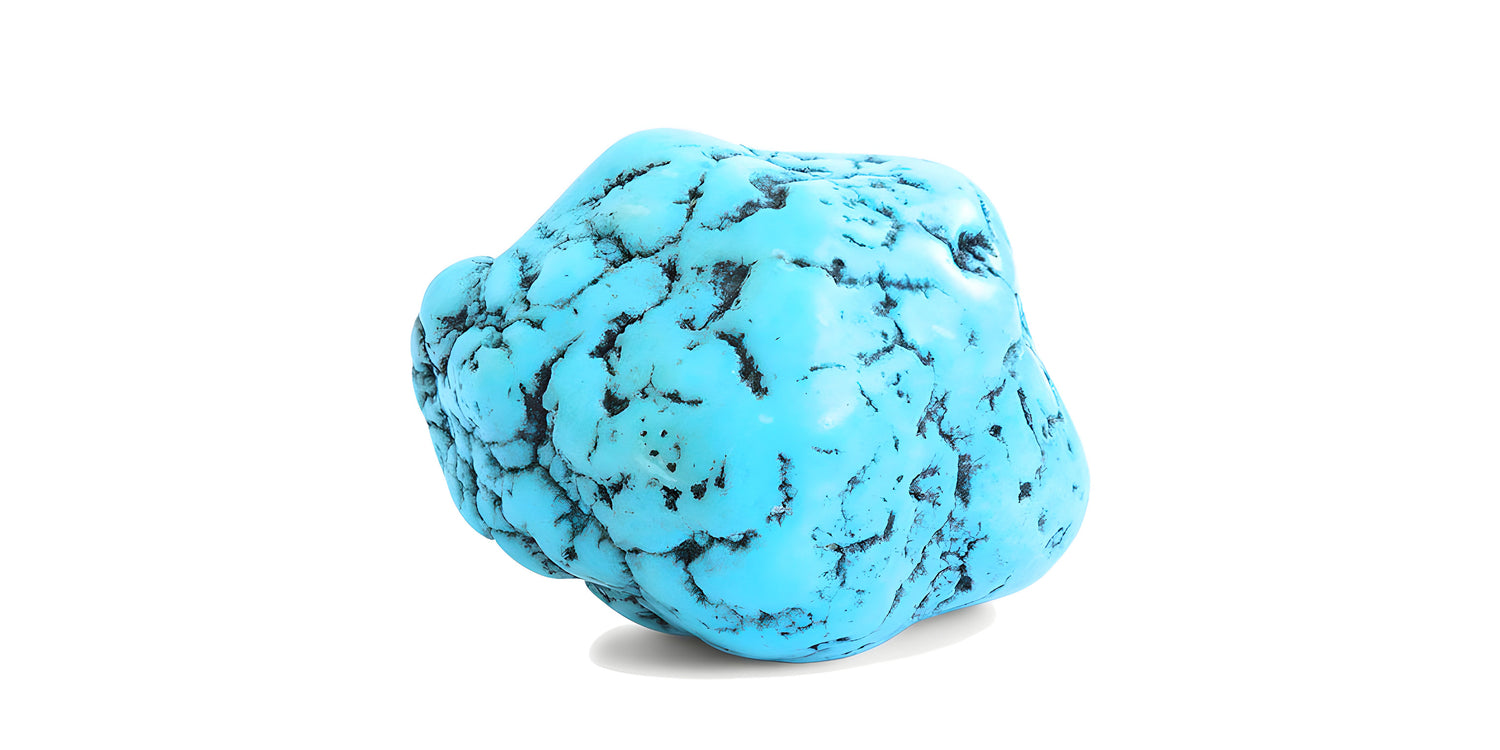
- Color(s): The colors of turquoise can vary from sky blue to green, depending on the amounts of copper (blue) and iron (green) present in the stone. Matrix inclusions (usually from the host rock) can also affect the overall appearance, creating patterns or veins.
- Symbolism: Turquoise is traditionally associated with self-expression. According to popular beliefs, it symbolizes the connection between sky and earth, offering an aesthetic of harmony.
Where does the name Turquoise come from?
Turquoise, with its captivating shades ranging from sky blue to green, holds a special place in human history and in the hearts of gem enthusiasts around the world. But where does the name "turquoise" actually come from? This question takes us on a journey through the history, culture, and trade that have shaped the perception and value of this gemstone over the ages.
Etymological Origins
The name "turquoise" originates from the French term for "Turkish," not because the stone came from Turkey, but rather because it was imported into Europe via trade routes passing through Turkey. In the Middle Ages, when these precious stones made their way from the mines of the Iranian plateau to European markets, they often entered the continent through Turkish merchants. France, playing a leading role in fashion and decorative arts at the time, adopted the name "Turkish stone" to describe this exotic and highly prized import. Over time, the name was simplified to "turquoise," a designation that, ironically, conceals the stone's true geographical origin.
The Turquoise Route
Turquoise was already known and used long before European traders discovered it through the Turks. The oldest known turquoise mines are located in the Sinai Peninsula, exploited as early as 4000 BC by the ancient Egyptians. However, it is Iran, with its legendary deposits, that has long been considered the primary source of the world's finest turquoise. Stones extracted from mines such as those in Nishapur are famous for their deep blue color and exceptional clarity.
As European demand for exotic and luxurious gems increased, trade routes stretching from Iran through Asia Minor and into Turkey became essential for international commerce. These routes not only facilitated the transfer of precious goods but also served as conduits for cultural and ideological exchanges between East and West.
Symbolism and Perception
The choice of the name "turquoise" reflects more than just a trade route; it attests to the exoticism and mystery that Europe associated with this stone. At a time when vivid colors and rare materials were highly valued in jewelry and decoration, turquoise stood out for its unique hue and distant origin. It was often associated with protection and prestige, beliefs that have been passed down through cultures and eras.
What is the history of Turquoise?
Turquoise, with its palette of vibrant blues and greens, is much more than a simple gemstone; it is a treasure of human history, imbued with traditions, mysticism, and profound cultural meanings. Its reputation spans millennia, crossing continents and civilizations, where it has been revered not only for its natural beauty but also for the powers and protections attributed to it.
Origins: Turquoise in Antiquity
The earliest uses of turquoise date back more than 5,000 years. The ancient civilizations of Egypt were among the first to mine and value this stone. The Sinai mines, already in operation as early as 3,200 BC, supplied turquoise that would adorn the jewelry, amulets, and even funerary decorations of Pharaohs and royal figures. Turquoise symbolized the deity of the sky, reflecting its color in the eyes of statues and inlays on funerary masks, such as that of the famous Tutankhamun.
Turquoise and Indigenous Cultures
In North America, turquoise also played a central role in indigenous cultures, notably among the Anasazi, Zuni, and Pueblo peoples, long before the arrival of Europeans. For these cultures, turquoise was not just an ornament; it held deep symbolism, representing protection. The Navajo, in particular, regard turquoise as a precious stone, traditionally associated with protection and fortune. It is often used in jewelry and ceremonies, symbolizing the sky and water, sources of life.
Turquoise in Asia and the Middle East
The Middle East and Central Asia also have a long history of turquoise use, particularly in Persia (modern-day Iran), where the Nishapur deposits are among the oldest and most renowned in the world. For the Persians, turquoise was a symbol of paradise on Earth, adorning mosque domes with its celestial hues. The stone was also a popular talisman against the evil eye and a symbol of purity and protection.
The European Renaissance and Turquoise
With the arrival of turquoise in Europe during the Middle Ages, its reputation as a protective stone spread. It became a precious component of Renaissance jewelry, believed to offer protection and good fortune to its wearer. Turquoise was especially prized by the ruling and royal classes, who wore it as a symbol of status and protection.
What is the origin and composition of Turquoise?
Turquoise is a fascinating stone that has captivated humanity for millennia, not only for its unique beauty but also for its complex composition and geological origin. To fully appreciate the value and uniqueness of turquoise, it is essential to delve into the details of its origin and chemical composition.
Geological Origin of Turquoise
The formation of turquoise is a geological phenomenon that occurs over very long periods. This gemstone is mainly formed by the process of chemical precipitation in copper-rich rocks under the effect of alteration caused by slightly acidic groundwater. These conditions are generally found in arid regions, where water evaporates quickly, leaving behind minerals that accumulate to form turquoise. Turquoise deposits are therefore often associated with copper mining regions, where the alteration of copper minerals in the presence of phosphates and aluminum gives rise to this precious stone.
Chemical Composition
Turquoise is a hydrated phosphate of aluminum and copper, with the chemical formula CuAl6(PO4)4(OH)8·4H2O. This unique composition gives it its characteristic colors, which can range from sky blue to green, depending on various factors such as the amount of copper (which tends to give a blue color) and sometimes iron (which can give a greener hue). The presence of rock matrix, or inclusions, can also influence the final appearance of the stone, giving it distinct patterns or veins.
Formation Process
The formation of turquoise begins when waters rich in copper and phosphate ions circulate through aluminosilicate rocks under arid climatic conditions. When these aqueous solutions evaporate, they leave behind mineral deposits that, over time, crystallize to form turquoise. This process can take several million years, making each turquoise deposit unique in terms of color, quality, and composition.
Color and Quality Variations
The color of turquoise is one of the main factors determining its quality and value. Stones displaying a uniform sky blue to blue-green color, without too many inclusions or matrix veins, are generally the most sought after. However, some cultures value the presence of matrix for its aesthetic appearance, which can give the stone a unique character and a visual connection to the land where it was formed.
Notable Deposits
The main turquoise deposits are found in arid regions around the world, notably in Iran (formerly known as Persia), the United States (Arizona, New Mexico, Nevada), China, Egypt, and Mexico. Each of these deposits produces turquoise with specific characteristics, influenced by the unique geology of the region.
What is the symbolism of the Turquoise stone?
Turquoise, with its hypnotic shades ranging from sky blue to deep green, is much more than just a gemstone. For millennia, across various cultures and civilizations, it has been considered a symbol of protection. The traditions attributed to turquoise are numerous, making it a particularly cherished stone for its history.
Traditional Symbolism
In ancient traditions, turquoise was often associated with vitality and strength. According to popular beliefs, it symbolized protection of the body, although it is above all appreciated for its radiant beauty.
Historically, some cultures attributed a symbolism of purity to this stone. In lithic tradition, it is seen as a symbol of renewal, often perceived as a sign of clarity.
Beliefs and Emotions
Symbolically, turquoise is traditionally associated with serenity and gentleness. Its blue and green hues evoke the harmony of nature, offering a comforting aesthetic.
In certain beliefs, it is linked to self-expression. Traditionally associated with communication, it is often seen as a symbol of eloquence and creativity.
Spiritual Traditions
Turquoise has also been renowned since antiquity for symbolizing wisdom. In spiritual traditions, it is often seen as a symbol of connection with the world around us.
Protection Myths
One of the most famous traditions regarding turquoise is its use as an amulet. According to popular beliefs, it symbolized protection against life's uncertainties, attracting positivity.
In traditional practices, it is often seen as a symbol of balance. Its soothing colors are traditionally associated with aesthetic harmony.
How to care for your Turquoise jewelry?
Turquoise, with its captivating shades ranging from blue to green, is a popular gemstone used in a variety of jewelry. However, its unique beauty requires special care to maintain its shine and color over time. Here is a detailed guide to caring for your turquoise jewelry, along with an invitation to discover our exclusive collections.
Gentle Cleaning
Turquoise is relatively porous and can absorb liquids, which may alter its color. To clean your turquoise jewelry, use a soft, dry cloth to gently wipe the surface of the stone. Avoid using chemicals, alcohol, or cleaning solutions, as they can damage the stone. For a deeper clean, you may slightly dampen the cloth with water, but be sure to thoroughly dry the stone and metal after cleaning.
Avoid Exposure
Turquoise jewelry should be protected from prolonged direct sunlight, which can discolor the stone. Likewise, avoid exposing it to high temperatures and humid environments, such as when swimming or showering, as water and heat can also alter the color and structure of the stone.
Proper Storage
To preserve the integrity of your turquoise jewelry, store it in a cool, dry place away from direct sunlight. It is best to keep them separately in soft pouches or lined jewelry boxes to avoid scratches caused by contact with other jewelry. This reduces the risk of damage and maintains the brilliance of the turquoise.
Careful Handling
Always handle your turquoise jewelry with care to avoid impacts that could cause cracks or chips. Remove your turquoise jewelry before engaging in intense physical activities or handling harsh chemicals to prevent accidental damage.
Traditional Care
In lithic tradition, natural stones are believed to need exposure to moonlight. While this is rooted in popular beliefs, this practice can be a symbolic way to renew your appreciation for your jewelry.
Discover Our Collections
After caring for your precious turquoise jewelry, why not explore our collections to add new treasures? Discover our collection of turquoise stone bracelets for women, offering elegance and unique style for any occasion. For men, our collection of turquoise stone bracelets for men features robust and refined pieces, perfect for adding a touch of originality to your outfit. Each piece is designed to highlight the natural beauty of turquoise, while offering exceptional comfort and durability.
Taking care of your turquoise jewelry ensures its longevity and beauty for years to come. By following these simple tips, you can protect these precious gems and continue to enjoy their unique brilliance.
The information presented in this article is provided for cultural and informational purposes, referencing the traditions and beliefs associated with stones. It does not constitute medical advice, a diagnosis, or a promise of results. Our bracelets are fashion jewelry and are not health devices. If you have a health problem, please consult a qualified healthcare professional.