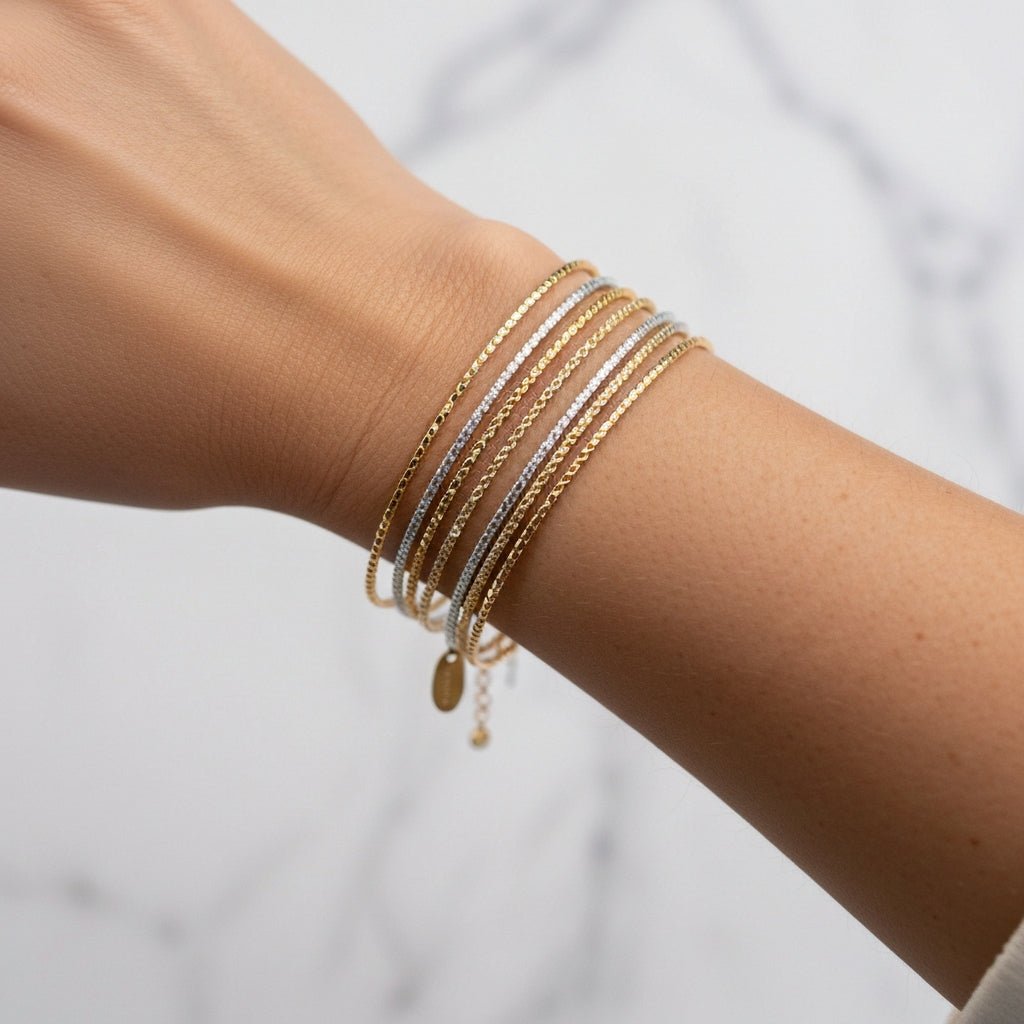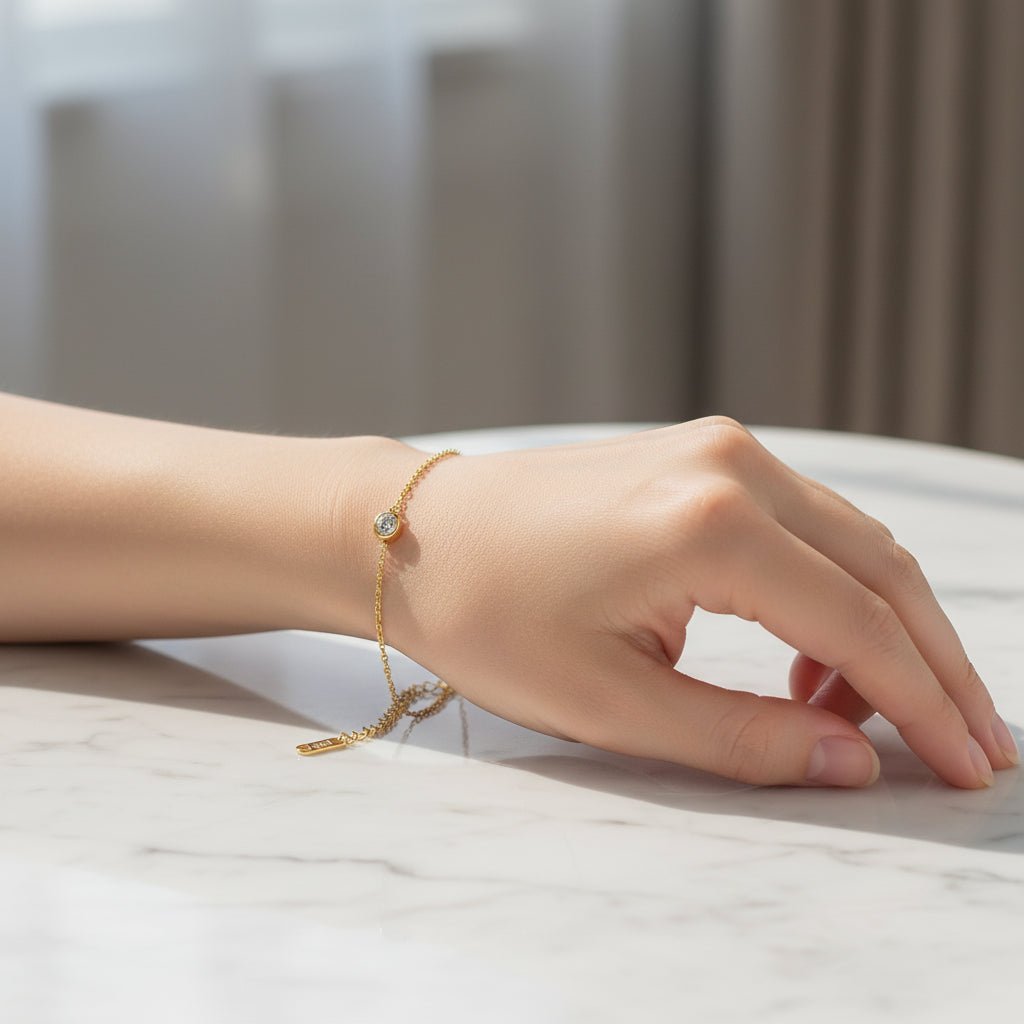
- Gold-tone stainless steel does not tarnish thanks to its chromium content (minimum 10.5%), which forms a self-regenerating protective layer called the passive layer.
- The PVD (Physical Vapor Deposition) coating used on quality jewelry creates a gold finish 10 times more durable than traditional gold plating.
- Unlike traditional gold plating, gold-tone steel resists water, perspiration, and everyday cosmetic products.
- Minimal care is enough: monthly cleaning with warm soapy water keeps the shine for years.
You have probably already experienced this disappointment: a gold bracelet that looked beautiful in the store, but turned dull and blackish after a few weeks. This frustrating oxidation affects many fashion jewelry pieces, but certainly not quality gold-tone stainless steel bracelets. The difference lies in fascinating materials science, which we will explore together.
At La Boutique du Bracelet, we receive questions every day about the durability of our gold-plated jewelry. "Does gold-plated steel tarnish?", "How long will the color last?" are among the most common questions. This article provides you with complete, scientifically based answers, so you can confidently invest in jewelry that stands the test of time.
The science behind stainless steel: why it resists oxidation
Chemical composition and the role of chromium
Stainless steel is not an ordinary metal. It is a sophisticated alloy composed mainly of iron, with at least 10.5% chromium added. This proportion is not insignificant: it is precisely the threshold at which a remarkable phenomenon called passivation occurs.
When chromium comes into contact with oxygen in the air, it spontaneously forms a thin layer of chromium oxide (Cr₂O₃) on the surface of the metal. This invisible film, only 1 to 3 nanometers thick, acts as a permanent protective shield. The most remarkable part? If this layer is scratched or damaged, it automatically reforms in the presence of oxygen.
316L steel: the standard of excellence in jewelry
In the world of high-end jewelry, 316L steel (also known as surgical steel) is the absolute benchmark. Its composition includes:
- 16 to 18% chromium for maximum anti-corrosion protection
- 10 to 14% nickel to improve strength and shine
- 2 to 3% molybdenum for increased resistance to chlorides (seawater, perspiration)
- Very low carbon content (L = Low) to prevent intergranular corrosion
This formulation explains why 316L stainless steel jewelry can be worn at the pool, in the shower, or during sports without any risk of alteration. This is also the steel used by surgeons for their instruments and by watchmakers for luxury watch cases.
PVD coating: the technology revolutionizing gold-toned jewelry
What is PVD plating?
PVD (Physical Vapor Deposition) is an industrial coating technique used in aerospace and luxury watchmaking, now available for jewelry. Unlike traditional electrolytic plating, which deposits gold by chemical bath, PVD uses a vacuum process at high temperature.
In practice, titanium and nitrogen atoms are vaporized and then projected onto the jewelry surface, creating a layer of titanium nitride (TiN) with exceptional hardness. This finish can be colored gold, rose gold, black, or even rainbow, depending on process parameters.
Why PVD outperforms traditional gold plating
The advantages of PVD coating are numerous and measurable:
- Superior hardness: 2300 HV (Vickers) versus 120 HV for pure gold, nearly 20 times harder
- Optimal thickness: 0.5 to 3 microns, thin enough to preserve jewelry details, thick enough to last
- Molecular adhesion: atomic bond with the substrate, impossible to peel off like classic plating
- Chemical resistance: inert to perfumes, creams, and household products
- Hypoallergenic: no risk of nickel allergy as it remains "sealed" under the PVD layer
Comparison: gold-toned steel vs other jewelry materials
Compared to traditional gold plating
Classic gold plating involves depositing a thin layer of gold (often 3 to 5 microns) onto a base metal by electrolysis. While attractive at purchase, this process has structural weaknesses: gold is very soft and wears quickly at friction points. In addition, the electrolytic bond is less durable than the atomic fusion of PVD, which explains frequent peeling.
Compared to vermeil
Vermeil is gold-plated sterling silver, with a minimum gold thickness of 2.5 microns according to French regulations. While more prestigious than gold-plated brass, vermeil remains vulnerable to the sulfuration of the underlying silver. Humidity and certain sulfur-rich foods can cause the jewelry to tarnish as sulfides migrate through the gold layer.
Compared to solid gold
18-carat solid gold contains 75% pure gold and truly never tarnishes. However, its malleability makes it vulnerable to deep scratches, and its price (about €60 per gram in 2024) means it is reserved for larger budgets. A solid gold bracelet will easily cost €500 to €2,000, compared to €30 to €80 for a visually equivalent quality PVD gold-plated steel bracelet.
Our selection of indestructible gold-plated steel and titanium bracelets
At La Boutique du Bracelet, we have selected pieces that combine refined aesthetics with proven durability. Here is our selection of bracelets that will never tarnish:
| Model | Material | Style | Feature |
|---|---|---|---|
| Slim and discreet gold-plated titanium bracelet with inlaid diamond, Zena model | Gold-plated titanium | Minimalist | Inlaid diamond, ultra-lightweight |
| Gold-plated titanium bracelet with gold pearls and crystal stones, Nancy model | Gold-plated titanium | Elegant | Pearls and crystals |
| Twisted bracelet in 18-carat gold-plated titanium, Belle model | 18K gold-plated titanium | Sophisticated | Iconic twisted design |
| Double chain titanium bracelet with inlaid stones, Kittie model | Titanium | Trendy | Double chain, gemstones |
| Flexible snake chain bracelet in chic gold titanium, Grace model | Gold titanium | Luxurious | Flexible snake chain |
| Stainless steel bracelet, eagle head clasp, Marian model | Stainless steel | Statement | Unique sculptural clasp |

Care tips to preserve the shine of your gold jewelry
The ideal cleaning routine
Even though gold stainless steel is remarkably resistant to daily wear, regular care will keep it shining longer. Here is the method recommended by professional jewelers:
- Prepare a mild solution: lukewarm water (not hot) + a few drops of Marseille soap or neutral dishwashing liquid
- Briefly immerse the bracelet for 2-3 minutes
- Gently scrub with a soft toothbrush to remove residue from the links
- Rinse thoroughly with clean water
- Dry immediately with a lint-free microfiber cloth
Recommended frequency: once a month for daily wear, or after each exposure to seawater or chlorinated water.
What you should absolutely avoid
Although durable, gold-plated steel does have a few enemies you should be aware of:
- Abrasive products: scouring powders, toothpaste (contrary to popular belief), baking soda
- Strong solvents: acetone, 90° alcohol, white spirit
- Thermal shocks: do not go from an ice-cold sauna to a heated pool instantly
- Prolonged contact with concentrated chlorine: remove your jewelry before handling household chlorine products
Optimal storage
To avoid micro-scratches between wears, store each bracelet individually in a velvet pouch or a jewelry box compartment. Metal-to-metal contact, even between two steel pieces, can create superficial marks over time.
2024-2025 trends: gold-plated steel at the heart of fashion
The return of luxurious minimalism
Runways and fashion influencers agree: gold jewelry dominates current trends, but with a more responsible approach. Gold-plated stainless steel perfectly meets the demand for accessible and lasting luxury. The Zena model, with its sleek design and discreet diamond, perfectly embodies this “quiet luxury” aesthetic favored by fashion houses.
Layering: the art of stacking
The bracelet stacking trend (layering several bracelets) requires pieces that can withstand mutual friction. Gold-plated steel excels at this: you can pair the Belle twisted bracelet with the Grace snake chain model without worrying about premature wear.
Rose gold: the trendy variant
The rose gold PVD coating uses the same technology as classic gold, with a coppery hue achieved by adjusting the deposition parameters. This warmer shade, very flattering on both fair and dark skin, offers a modern alternative to traditional yellow gold.

FAQ: Your questions about gold-plated steel bracelets
Can gold-plated stainless steel really be worn in the shower?
Yes, absolutely. 316L stainless steel with PVD coating is designed to withstand daily water exposure. Tap water, even if hard, does not affect the metal or the gold finish. The only precaution: dry your bracelet after prolonged exposure to water to avoid limescale marks.
How long does the gold plating last on steel?
Between 5 and 20 years depending on the quality of the PVD coating and how often it is worn. A bracelet worn daily with minimal care will keep its shine for at least 5 years. Pieces worn occasionally can remain flawless for several decades.
Does gold-tone stainless steel cause allergies?
No, 316L steel is hypoallergenic. Even people sensitive to nickel can wear these pieces, as the PVD coating creates a waterproof barrier between the skin and the underlying metal. That’s why surgical steel is used for piercings and medical implants.
How can you tell real stainless steel from an imitation?
Three simple tests: 1) The magnet should not stick (316L steel is non-magnetic). 2) The weight should be substantial (steel is heavier than brass). 3) No reaction after prolonged contact with salt water. At La Boutique du Bracelet, all our jewelry is certified 316L steel or titanium.
Can a gold-tone stainless steel bracelet be resized or repaired?
Yes, with a qualified jeweler. Stainless steel requires specific tools (different from those for gold or silver). Adding or removing links is generally possible. However, if the PVD coating is locally damaged, only a complete re-treatment can restore it.
Is gold-tone stainless steel eco-friendly?
More than just alternatives. Stainless steel is 100% recyclable, endlessly, with no loss of quality. Its outstanding durability reduces the need for frequent replacement. The PVD process generates little waste, unlike electroplating which uses polluting chemical baths.
Conclusion: invest in durability
As you can see, gold-tone stainless steel bracelets are much more than an affordable alternative to solid gold. Thanks to PVD technology and the exceptional properties of 316L steel, these pieces offer oxidation resistance equal to or even greater than traditional precious metals.
At La Boutique du Bracelet, we have chosen to offer only pieces whose quality of craftsmanship guarantees uncompromising durability. Whether you are looking for a subtle bracelet like the Zena model or a bolder piece like the Léo bracelet with inlaid chain, you can be sure of a piece of jewelry that will stand the test of time without ever tarnishing.
True luxury today is being able to wear your favorite jewelry in any situation, without worry or restriction. Gold-plated stainless steel gives you this freedom.